
Robotic Assisted
Adrenalectomy
in Chennai
Minimally invasive removal of adrenal gland tumours on the da Vinci Xi reaching the gland in its deep position above the kidney through tiny keyhole incisions, with less pain and a faster recovery than open surgery.
What is an adrenal gland tumour, and how it affects you
The adrenal glands sit on top of each kidney and are part of the endocrine system. Adrenal tumours are rare but important and can be benign or malignant.
Because these glands make hormones that regulate metabolism, immune function and blood pressure, a tumour can disturb that balance. Hormone-related effects can include Cushing's syndrome, Conn's syndrome and phaeochromocytoma, alongside symptoms such as abdominal pain or fullness, unexplained weight loss, muscle weakness, skin changes and mood changes.
Imaging is central to diagnosis, and treatment depends on the type, size and nature of the tumour. Surgery is often the main treatment — and today it is usually performed as a minimally invasive robotic adrenalectomy, which is generally less risky than open surgery. In some cases a partial adrenalectomy removes the tumour while preserving the rest of the gland.
Exploring adrenal tumour treatment safely
Modern medicine offers highly effective, safe pathways for adrenal tumours. Depending on the diagnosis, your doctor may recommend surgery (robotic adrenalectomy), hormone-blocking medication, and — for certain cancers — radionuclide therapy or chemotherapy.
Surgery to remove the tumour, called adrenalectomy, is often the main treatment. It can be performed open, laparoscopically, or with robotic assistance. The robotic approach allows the surgeon to operate with high precision through a few tiny keyhole incisions — usually a safer procedure with less scarring, less pain and a quicker recovery than traditional open surgery.
Why robotic for the adrenal gland
-
 Deep, delicate location — the gland sits high above the kidney
-
Magnified 3D vision — precise dissection near major vessels
-
Tiny keyhole incisions — less pain, minimal scarring
-
Gland-sparing option — partial adrenalectomy where suitable
Hormone-Producing Tumours
Tumours that overproduce adrenaline, aldosterone, or cortisol cause high blood pressure or other issues, which are resolved through removal.
Suspicious or Growing Masses
Adrenal masses that require removal based on size, imaging characteristics, or growth over time to diagnose and treat effectively.
Larger Adrenal Tumours
Tumours that exceed a size suitable for safe observation are better addressed with keyhole removal.
And when it isn':
Many small, incidental adrenal' incidentalomas” discovered incidentally require only monitoring and hormone testing, not surgery. Larger adrenal tumours exhibiting signs of invasive adrenal cancer (adrenocortical carcinoma) are generally better excised through open surgery to achieve complete removal without damaging the tumour, a method aligned with EAU/ESES guidance. The appropriate treatment depends on imaging and hormone evaluation.
Benefits of robotic adrenalectomy
For a gland in such a deep, confined space, robotic precision is especially valuable.
High precision
Magnified 3D vision and wristed instruments for accurate removal near major vessels.
Minimally invasive
A few tiny keyhole incisions rather than a large open cut.
Less blood loss
Fine control around the adrenal vein typically reduces bleeding.
Less pain & scarring
Smaller wounds mean less discomfort and better cosmetic results.
Quicker recovery
A faster return to normal activities than after open surgery.
Gland-sparing option
The procedure & your recovery
Consultation- hormone and imaging workup
Blood and urine tests are used to determine if the tumour produces hormones, while CT or MRI scans are employed to characterise it. This evaluation helps decide whether surgery is necessary and how to prepare for it, which is essential before any adrenal surgery.
Preparation
Hormone-producing tumours are prepared specifically for instance, administering blood- pressure medication before phaeochromocytoma surgery through collaboration between endocrinology and anaesthesia to ensure a safe operation
Surgery
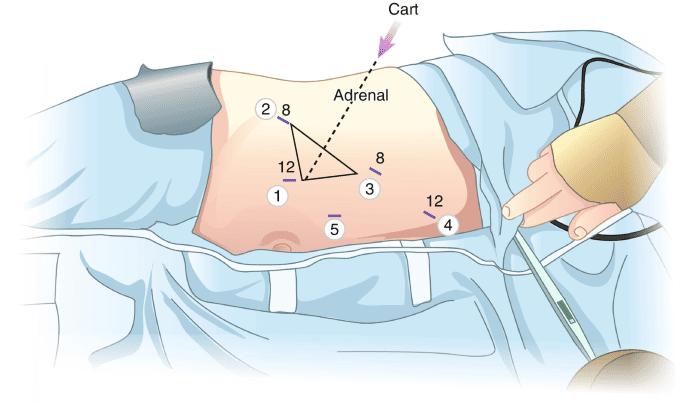
Under general anaesthesia, keyhole ports are inserted; the adrenal gland is carefully separated from the kidney and major vessels, its blood supply is controlled, and the gland is removed in one piece in a retrieval.
Hospital stay
Most patients ambulate on the same evening, eat the following day, and are discharged within 1-2 days. Hormone-producing tumours are monitored to confirm the resolution of their effects..
Follow-up
Final pathology confirms the tumour type. Blood pressure and hormone levels are rechecked, often showing improvement, and follow-up is scheduled as necessary.
Finding the best adrenal surgeon
Dr. A.K. Jayaraj is a recognised robotic surgery expert and top-tier adrenalectomy surgeon, bringing extensive experience and technical expertise to every case of robotic adrenalectomy. He has dedicated his practice to mastering minimally invasive techniques.
His focus is careful, precise removal of the adrenal tumour to maximise long-term function and a safe, durable result — with the personal attention patients value.
- Robotic adrenalectomy surgeon
- Adrenal gland removal specialist
- da Vinci Xi minimally invasive surgery
- 20+ years of surgical experience

Robotic adrenalectomy FAQs
The cause is often unknown, but risk can be linked to a family history or certain genetic syndromes, or a history of a previous adrenal tumour. Tumours are detected with blood and hormone tests, a CT scan and an MRI. Some produce excess hormones causing Cushing's syndrome, Conn's syndrome or a phaeochromocytoma.
Treatment varies based on the tumour's type, size, and characteristics, along with your overall health. Surgery to excise the tumour (adrenalectomy) is typically the primary treatment; alternative options may involve hormone-blocking drugs and, in certain cancers, radionuclide therapy or chemotherapy. When appropriate, a partial adrenalectomy can remove the tumour while conserving the remaining gland.Treatment varies based on the tumour's type, size, and characteristics, along with your overall health. Surgery to excise the tumour (adrenalectomy) is typically the primary treatment; alternative options may involve hormone-blocking drugs and, in certain cancers, radionuclide therapy or chemotherapy. When appropriate, a partial adrenalectomy can remove the tumour while conserving the remaining gland.
The robotic approach is minimally invasive, involving just a few tiny keyhole incisions, high- precision instruments, and magnified 3D vision. Compared to open surgery, it typically results in less scarring, less pain, and a faster recovery, as the gland located deep above the kidney is removed with exceptional accuracy.
Seek a surgeon with extensive, specialised experience in robotic adrenal surgery and minimally invasive methods. Dr. A.K. Jayaraj is a noted expert in robotic surgery, focusing his practice on these procedures.
Related care & procedures
Book a robotic adrenalectomy consultation
of the safest approach to your adrenal tumour — or for a second opinion.