
Robotic Partial Nephrectomy
in Chennai
Kidney-sparing, minimally invasive surgery on the da Vinci Xi removing the tumour while preserving as much healthy kidney as possible, through a few 1 cm keyhole incisions with less blood loss and a faster recovery than open surgery.
Robotic partial nephrectomy — advanced kidney surgery
Partial nephrectomy removes the kidney tumour while sparing the healthy part of the kidney protecting your long-term kidney function.
By removing only the cancerous lesion instead of the whole kidney, more functioning kidney tissue is preserved, which has been shown to lower the risk of future cardiovascular problems. It is typically considered when the tumour is under about 7 cm, or when a patient has only one kidney.
For years the only option was open surgery — a large 8–12 inch incision in the flank, sometimes requiring removal of a rib. Robotic partial nephrectomy instead uses a minimally invasive approach through a few small cuts, delivering a cancer-control rate comparable to open surgery but with far less pain and a much quicker recovery.
What is a partial nephrectomy, and when is it needed?
Nephrectomy is the key surgical step for serious kidney problems such as cancer, tumours, injuries or complex disease. There are two types: partial and radical. Partial nephrectomy also called kidney-sparing or nephron-sparing surgery meticulously removes only the tumour or damaged section, leaving the rest of the healthy kidney in place.
It is the preferred choice for most small tumours in healthy patients, and is often the path taken for a larger tumour when the other kidney is not strong enough to manage alone. The priority is always to remove the tumour while sparing as much kidney as possible, to protect your health for years to come. If a cancer is too large or involves vital parts of the kidney, a radical nephrectomy removing the whole kidney may be the safer way to be sure the cancer is gone
How the robotic procedure works
-
 3–4 keyhole incisions — about 1 cm each
-
Magnified 3D vision — the surgeon operates from a console
-
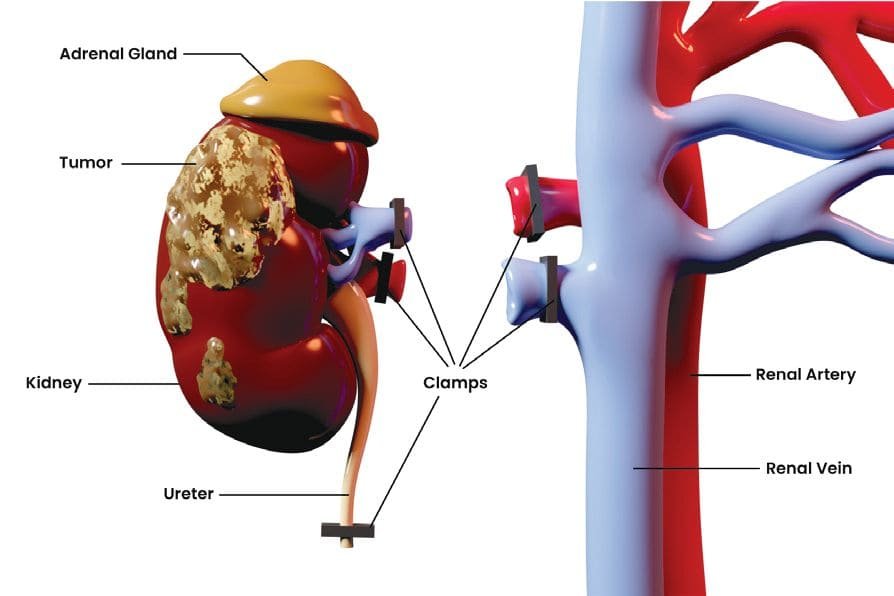
Controlled blood flow — briefly clamped to remove the tumour cleanly
-
Robotic suturing — the kidney defect is repaired precisely
-
Retrieval bag — the tumour is removed through one small cut
Why choose robotic over open
kidney surgery?
In suitable patients, the robotic approach offers real advantages over open surgery for both cancer control and recovery.
Kidney function preserved
Less blood loss
Smaller incisions
A few 1 cm keyholes instead of a large flank cut less pain, minimal scarring.
Improved visualisation
Quicker recovery
Shorter hospital stay
How a UTI is assessed
Consultation
A contrast CT or MRI maps the tumour’s size, depth and relationship to the kidney’s vessels and drainage the blueprint for a kidney-sparing excision. Kidney function in both kidneys is assessed, and the plan is confirmed with you.
Surgery
Under general anaesthesia, keyhole ports are placed; the kidney's vessels are identified and briefly clamped; the tumour is excised with a clear margin, and the kidney is reconstructed with sutures all on the da Vinci Xi, within a controlled clamp time.
Hospital stay
Most patients walk the same evening, eat the next day, and go home in 2–3 days. The excised tumour is sent to pathology for its type and margins.
Healing
Light activity resumes over a couple of weeks; drain removed within about a week if used.
Follow-up
Imaging and kidney-function surveillance are scheduled as per guidelines, monitoring for any recurrence and for the health of both kidneys over time
Why choose Dr. A.K. Jayaraj
Dr. A.K. Jayaraj is a recognised robotic nephrectomy specialist and a top-tier kidney surgeon, bringing extensive experience to every partial and radical nephrectomy. He has dedicated his practice to mastering minimally invasive techniques — with a focus on maximising kidney function and getting patients back to normal life sooner.
His priority is careful, complete tumour removal while sparing as much healthy kidney as possible, giving patients a safe, durable, long-term result.
- Robotic nephrectomy specialist
- Kidney-sparing (nephron-sparing) focus
- da Vinci Xi kidney surgery
- 20+ years of surgical experience

Robotic partial nephrectomy FAQs
Recovery is generally faster and more comfortable than after open surgery. Most patients stay in hospital for about 1–3 days, and full recovery is usually expected within 4–6 weeks, with less pain and minimal scarring, while your kidney function is protected. A wound drain is sometimes left in place for up to a week.
Yes, robot-assisted kidney surgery is well established for kidney tumours and, in suitable patients, offers smaller incisions, a shorter blood cut-off (ischaemia) time, less blood loss and a quicker recovery than open surgery. As with any surgery, there are risks, which are discussed with you beforehand.
Whenever the tumour allows, a partial nephrectomy (sparing the healthy kidney) is preferred because preserving kidney function is linked to better long-term health, including a lower risk of future cardiovascular problems. Radical nephrectomy is chosen when the tumour is too large or too central to remove safely while preserving the kidney.Whenever the tumour allows, a partial nephrectomy (sparing the healthy kidney) is preferred because preserving kidney function is linked to better long-term health, including a lower risk of future cardiovascular problems. Radical nephrectomy is chosen when the tumour is too large or too central to remove safely while preserving the kidney.
Partial nephrectomy is generally suited to smaller kidney tumours (often under about 7 cm), tumours in a favourable position, or when you have only one functioning kidney. Suitability is confirmed with CT/MRI imaging and discussed during consultation..
Related care & procedures
Book a robotic partial nephrectomy consultation
whether kidney-sparing robotic surgery is right for you
— or for a second opinion on a kidney tumour.